IMS rolling on! Quiet and Steady
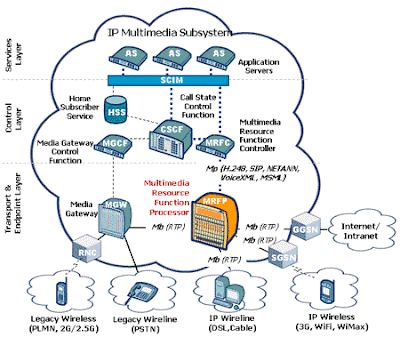
IP Multimedia Subsystem (IMS) is expected to provide mobile telephone operators with a forecasted $300 billion in extra revenue over the next five years, according to a new study from ABI Research. Major operators such as Sprint, Verizon and British Telecom (BT) will increasingly deploy IMS across their networks in a quickening tempo starting this year.
“Until recently IMS was mainly the province of fixed-line operators,” says senior analyst Nadine Manjaro, “but now it is essential to the success of mobile and fixed operators who are losing revenue from traditional sources. IMS enables rapid development and deployment of new services.”
Some firms – notably Verizon and BT – are facilitating this process by offering an open IMS interface allowing third-party developers easy access, as a way of ensuring a flow of new applications. This means faster testing and deployment of services, which will be critical to their success.
“Operators are forced to look at IMS and similar solutions because they need to start generating more revenue,” notes Manjaro. “With recent moves by Sprint, Verizon and AT&T to offer less profitable flat rate services as a way to fight subscriber churn, that need becomes more acute.”
One impediment to IMS’s success in the past has been the difficulty of proving the business case for it. But Manjaro suggests that planners were incorrectly considering IMS as a service rather than a platform. In fact IMS supports multiple services, and it takes several of them to make a valid business case. To use the hackneyed phrase, there has been a paradigm shift in operators’ strategic thinking.
The major remaining challenge for operators is to integrate IMS without seriously disrupting existing services. That need is being met by the major infrastructure vendors such as Ericsson, Alcatel, and Nokia-Siemens, which have been packaging IMS (at additional cost) with the network upgrades they provide to operators. Manjaro points out that, “It’s easier to quantify the opportunity for operators because you can look at it in terms of potential revenue. It’s more difficult with regard to vendors, because they’ve been bundling it with the air interface, the base station, the architecture upgrade.”
In other new IMS pulse-taking – Forward Concepts’ ‘Femtocells: The Emerging Solution for Fixed Mobile Convergence’ report – it’s predicted that IMS-powered femtocells will capture the dominant fixed-mobile convergence (FMC) market share by 2010. The argument here is that Unlicensed Mobile Access (UMA) is a transitional technology and cellular carriers will ultimately transition to IMS-enabled femtocells. Forward Concepts calculates that global femtocell equipment revenues will grow at a CAGR of 126% from 2008 to hit US$4.9bn in 2012. Western Europe will be the largest market, driving 32% of the revenue, followed by North America with a 22% share.
Check my old blog on IMS and UMA.
 The IMS (IP Multimedia Subsystem) and the NGN (Next Generation Networks) Forums announced recently the successful completion of interoperability testing at the IMS Forum Plugfest 4 and plans for the NGN Plugfest 5. Plugfest 5, scheduled for June 2008 at the University of New Hampshire InterOperability Lab (UNH-IOL), will test consumer and enterprise M-play interoperability.
The IMS and NGN Forums are dedicated to interoperability and certification of M-play, mobile multimedia services, and applications for wireless, wireline, and cable broadband over IP networks.
The
IMS Forum
&#
8217
;
s
Plugfest
4
,
held
at
the
UNH
-
IOL
Feb
25
&#
8211
;
29
,
was
the
latest
in
a
series
of
events
designed
to
deliver
IMS and
NGN
interoperability
and
certification
.
Participating
companies
tested a number of leading technologies and
services
for
interoperability
,
including
triple
play
,
VoIP
(
voice
over
IP
),
fixed
mobile
convergence
(
FMC
)
from
multiple
vendors
,
test
and
measurement
equipments
,
SIP
(
session
initiation
protocol
),
class
-
5
features
(
voicemail
,
etc
),
Diameter
IMS stacks
,
and
instant
messaging
with
presence
support
.
Plugfest
4
was
the
first
successful
IMS call
between
mobile
UE
(
user
equipment
)
devices
and
core
network
elements
P
-
CSCF
servers
,
S
-
CSCF
,
and
HSS
,
all
from
separate
vendors
.
Plugfest 4 was expanded to include billing interfaces for charging for IMS services. Tests included an IMS-compliant charging/billing system working with multiple network configurations, as well as interoperability of operational support systems and business support systems (OSS/BSS). This is a major milestone since the charging/billing systems are a major component for network operators to deploy IMS.
More than 15 companies participated in IMS Plugfest 4, including Intel as a platinum sponsor, HP, Amdocs, Acision, Alpha Networks, Aricent, Data Connection Ltd., Empirix, Mavenir Systems, Mu Security, NextPoint Networks, Radvision, Shenick Network Systems, Sonus Networks, Starent Networks, Tekelec, and UNH-IOL. PulverMedia and IMS Magazine served as media sponsors.
Finally, Ericsson has announced an agreement with Beijing Netcom, a branch of China Netcom, to provide the company with a Command Supporting System based on Ericsson’s IMS solution for the Beijing Olympic Games.
China Netcom is the official fixed-telecom service partner for the Beijing 2008 Olympic Games. Under the agreement, Ericsson will be the sole supplier and systems integrator for an IMS (IP Multimedia Subsystem) platform to enable personal multimedia communication.
Ericsson’s IMS solution enables the convergence of data, speech and network technology over an IP-based infrastructure. It supports fast and efficient management and coordination of value-added services, including voice, text, pictures and video, providing end users with a personalized, richer communications experience.
Deployment and systems integration has started and is set to be completed by March 2008. It will span the six Olympic Games cities in China.
The agreement is an extension of a contract signed between Ericsson and Beijing Netcom in April 2007 to build the first commercial IMS network in China.
Beijing Netcom says: “As an official partner for the 2008 Beijing Olympics, this agreement emphasizes our commitment to providing telecom-quality IP multimedia services that combine voice, data, audio and video. This move will bring an enhanced communications experience to users in Beijing and across other Olympic cities.”
Mats H. Olsson, President of Ericsson Greater China, says: “Ericsson is extremely proud to build on its longstanding relationship to provide Beijing Netcom with the first IMS-based multimedia service for the 2008 Olympic Games. This contract confirms that IMS has come of age, enabling volume deployment supporting multimedia capabilities within the fixed-network operator’s service.”
Ericsson is the world’s leading provider of technology and services to telecom operators. The market leader in 2G and 3G mobile technologies, Ericsson supplies communications services and manages networks that serve more than 185 million subscribers. The company’s portfolio comprises mobile and fixed network infrastructure, and broadband and multimedia solutions for operators, enterprises and developers. The Sony Ericsson joint venture provides consumers with feature-rich personal mobile devices.
Incoming search terms for the article:
Related posts
Tags: , British Telecom, business-case, Existing Services, Hackneyed Phrase, Ims, Infrastructure Vendors, Ip Multimedia Subsystem, Line Operators, Manjaro, Multiple Services, Network Upgrades, Next Five Years, nokia-siemens, Paradigm Shift, Party Developers, Rapid Development, rolling 3g technology, Senior Analyst, Telephone Operators, Traditional Sources, Valid Business


 The IMS (IP Multimedia Subsystem) and the NGN (Next Generation Networks) Forums announced recently the successful completion of interoperability testing at the IMS Forum Plugfest 4 and plans for the NGN Plugfest 5. Plugfest 5, scheduled for June 2008 at the University of New Hampshire InterOperability Lab (UNH-IOL), will test consumer and enterprise M-play interoperability.
 Powered by
Comments
Tell us what you're thinking...
and oh, if you want a pic to show with your comment, go get a gravatar!