All about F-DPCH
 Fractional DPCH was added in Rel-6 to optimise the consumption of downlink channelization codes. When using HS-DSCH (High Speed Downlink Shared Channel), the main use for DL DPCH (also known as A-DPCH where A stands for Associated) is to carry power control commands (TPC bits) to the UE in order to adjust the uplink transmission. If all RBs (Radio Bearers) including SRBs (Signalling Radio Bearers) are mapped on to HS-DSCH then the DL codes are being wasted. SF 256 is used for A-DPCH and so every code being used by a user is seriously depleting the codes available for other UE’s. To overcome this F-DPCH is used so that multiple UE’s can share a single DL channelisation code. The limitation is 10 UEs in Rel-6.
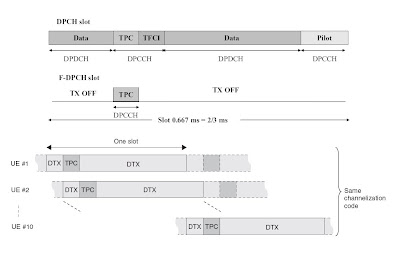
For several users, the network configures each user having the same code but different frame timing and, thus, users can be transmitted on the single code source. The original timing is thus retained which avoids the need to adjust timings based on Release 99 power control loop implementation.
During slots where the DPCCH is not transmitted, the NodeB cannot estimate the uplink signal-to-interference ratio for power-control purposes and there is no reason for transmitting a power control bit in the downlink. Consequently, the UE shall not receive any power control commands on the
F-
DPCH in
downlink slots corresponding to inactive uplink DPCCH slots.
There are some restrictions for FDPCH. It is not usable with services requiring data to be mapped to the DCH, such as AMR speech calls and CS video. Also, the lack of pilot information means that a method like feedback-based transmit diversity (closed loop mode) is not usable. The use of closed loop diversity is based on user-specific phase modification, wherein pilot symbols would be needed for verification of the phase rotation applied. On the other hand, when utilizing the
F-
DPCH, SRBs can benefit from high data rates of HSDPA and reduce service setup times remarkably
Finally, as you may have already figured out, by using
F-
DPCH the cell capacity has been improved and at the same time for same number of users, the interference has gone down significantly.
In Release 7, Rel-6 limitation has been removed. In R6, for a given UE in soft handover the TPC from all
F-
DPCH had to have the same offset timing. In R7,
F-
DPCH (TPC bits) can have different timing from different cells. This is possible due to introduction of 9 new
F-
DPCH slot formats (slot format 0 is the legacy
F-
DPCH slot format). The RRC signalling is done seperately for slot formats from the RNC to each of the cells.
You may also be interested in this Ericsson paper titled “The effect of
F-
DPCH on VoIP over HSDPA Capacity”. Available
here.
Incoming search terms for the article:
Related posts
Tags: 3g dpch, 3g DPCH power offset, 3G F-DPCH, 3G F-DPCH timing, 3g fractional DPCH, 3gpp f-dpch slot format, A-DCH F-DPCH, A-DCHとは, a-dpch, Amr, capacity per cell UMTS HSDPA F-DPCH, channelisation code f-dpch, Consumption, Control Bit, Control Loop, Control Purposes, CPC F-DPCH, Dch, Diversity, DL DPCH, DL F-DPCH, DL Slot format and NodeB, Downlink Slots, dpch, dpch 3G, DPCH AMR, dpch channedl, dpch channel, DPCH codes, DPCH downlink code power, DPCH Pilot bits, dpch power control info, dpch power offset, dpch slot, dpch slot format, DPCH Vs F-DPCH, DPCH/F-DPCH EHICH, dsch category iphone 4, f, f 3g technology, F DPCH R7, f-dcph usage, F-DPCH, f-dpch associated, f-dpch associated DPCH, f-dpch category, F-DPCH CELL-DCH, f-dpch channel, F-DPCH channelisation, F-DPCH CPC, F-DPCH DL-DPCH, F-DPCH Downlink Power Control Ericsson, f-dpch dpch, F-DPCH in 3g, F-DPCH in WCDMA, f-dpch inactivity timer, F-DPCH mandatory for rel-7 UEs?, F-DPCH mobile phone, F-DPCH multiple, F-DPCH offset, F-DPCH pilot, f-dpch pilot bits, F-DPCH power, F-DPCH restrictions, F-DPCH support, F-DPCH timing, f-dpch tpc format 3gpp, F-DPCH U-DPCCH, f-dpch uplink, F-DPCH usage in WCDMA, F-DPCH users per code, F-DPCH vs DPCH, f-dpchとは, FDPCH, fdpch hsdpa, FDPCH Overview, fdpch umts, fractional DPCH, fractional dpch soft handover, fractional DPCH support rel 6, Fractional dpch wcdma, frame structure for DL DPCH channel in HSDPA, franctional DPCH, f_DPCH, high-speed, how to know a modem supports F-DPCH, hs associated dpch, hs-dsch and f-dpch, HS-DSCH category for iphone, hsdpa, hsdpa channels f-pdch, Implementation, Interference, introduction to F-DPCH, Loop Mode, MODEM USB HSDPA R6 900MHZ, mss, Nodeb, Phase Rotation, pilot, power conrol downlink soft handover F-DPCH, Rbs Radio, Rel 6 F-DPCH, rel 7 UE F-DPCH 3gpp, role of f-dpch channel, SF do DPCH, SF256 3g, SF256 articles, testing fdpch, The effect of F-DPCH on VoIP over HSDPA Capacity, Ue, ue category for F-DPCH, Ues, Uplink Signal, usage of F-DPCH, use of F-DPCH, verify rel 7 Ue with Continuous packet connectivity, what is A-DPCH, what is dpch, WHAT IS DPCH IN 3G, what is F-DCPH in 3G, what is f-dpch, what is fractional dpch, what is HS DSCH category for iphone 3gs ?, what is the DPCH, when is f-dpch used, why fdpch


 Fractional DPCH was added in Rel-6 to optimise the consumption of downlink channelization codes. When using HS-DSCH (High Speed Downlink Shared Channel), the main use for DL DPCH (also known as A-DPCH where A stands for Associated) is to carry power control commands (TPC bits) to the UE in order to adjust the uplink transmission. If all RBs (Radio Bearers) including SRBs (Signalling Radio Bearers) are mapped on to HS-DSCH then the DL codes are being wasted. SF 256 is used for A-DPCH and so every code being used by a user is seriously depleting the codes available for other UE’s. To overcome this F-DPCH is used so that multiple UE’s can share a single DL channelisation code. The limitation is 10 UEs in Rel-6.

 Powered by WordPress ·
Comments
Tell us what you're thinking...
and oh, if you want a pic to show with your comment, go get a gravatar!