 Picked this up from Martin’s Blog. One of the things that has been left undefined are the end user applications. Unlike GSM and 3G+ where AMR RAB’s has been defined for CS voice calls, there is no provision in LTE. In fact we know that CS domain is completely absent and only IP based PS domain is present. It has been assumed that IMS will be de-facto present along with LTE and the architecture rightly defines so but there is nothing stopping LTE being deployed without IMS. The following is from Martin’s Blog:
LTE requires the IP Multimedia Subsystem (IMS) for voice calls. So what will happen to LTE if IMS doesn’t take off? I know, many in the industry believe even asking such a question is close to heresy but who can promisse today that IMS will be a success?
The trouble with IMS and to some extent with mobile VoIP is not that it’s a young technology, standardization has been going on for many years and books about it are going into their third edition. However, there are still no IMS systems out there today that have come out of the trial phase, and I have yet to see a mobile device with an IMS client which is nicely integrated and simply works. Also, the IMS standard is getting more complicated by the day which doesn’t make life easier. Another main issue with VoIP and consequently IMS is power consumption. I use VoIP over Wifi a lot on my Nokia N95 and can nicely observe how the phone slightly heats up during a long phone call. Also the non-IMS but SIP compliant Nokia VoIP client in the phone, which by the way is nicely integrated, sends keep alive messages to the SIP server in the network several times a minute. This is necessary mainly due to Network Address Translation (NAT). While this doesn’t require a lot of power over Wifi, power consumption skyrockets as soon as I configure VoIP for use over 3G. I can almost watch the power level of the battery drop as the network now constantly keeps a communication channel open to the device. So there are two problems here: VoIP calls cause a much higher processor load during a call, i.e. the VoIP talk time is much shorter than the 2G or 3G talk time and the standby time is significantly reduced. Add to that the missing handover capability to 2G and 3G networks (yes, I know there is VCC in theory) and you have a prefect package for a very bad user experience.
So the big question is if all of these things can be fixed, say over the next 5 years!? I have my doubts… If not, then LTE has a big problem. Will network operators accept running GSM or HSPA alongside LTE until the problems are fixed? The choice is this and accepting that LTE is for Internet access and some niche VoIP applications on devices such as notebooks or to decide sticking to HSPA(+) until things are fixed.
In case LTE is deployed and LTE – IMS devices are not ready it’s likely that a device can’t be attached to several radio networks simultaneously. So how do you inform a device attached to LTE about an incoming voice call? It looks like the people in standards bodies are looking at different solutions:
- Send a paging message for an incoming circuit switched voice call via LTE to the device. You can do this on the IP layer or on the radio network signalling layer. The device them switches radio technologies and accepts the call.
- Some people have started thinking about extending LTE with a circuit switching emulation.
This could be handled on the lower layers of the protocol stack and the software on top would not notice if the call uses GSM, UMTS or LTE. This one is easier said than done because I don’t think this concept will fly without a seamless handover to a 2G or 3G network. If such a solution ever gets into mobile phones, it would make life for IMS even harder. Who would need it then?
Are there any other initiatives I have missed so far to fix the LTE voice issue?
Dean Bubley in his Disruptive Wireless Blog has interesting analysis on this topic as well:
My view is that operators should either work with Skype, Truphone, fring et al – or compete head-to-head with them using their own pre-standard mobile VoIP implementations. I still believe this is a good route to VoIPo3G, especially for operators that are already moving to VoIP in their fixed networks, or which are early deployers of IMS or other IP-NGN architectures. Blocking VoIP it not a viable option in competitive markets – as evidenced by the increasing trend towards openness that’s been seen in recent weeks.
But interestingly, another ‘flavour’ of mobile VoIPo3G is now emerging as an alternative for mobile operators – Circuit Switched Voice over HSPA, as an early specification within 3GPP’s Release 8 generation of standards. This was just starting to evolve seriously when I published the report in November, and is mentioned in the comments on this post of mine. And it now seems to be moving fast. In the last week, two of the largest ‘’movers and shakers’ in mobile technology – from both handset and network sides – have talked up this approach to me unprompted. And I’m in agreement that it’s undoubtedly going to be important.
Basically, CS voice over HSPA takes the ordinary mobile circuit voice service, using ordinary diallers on the phone, and circuit core switches in the network… and tunnels it over an underlying IP bearer. So the application isn’t VoIP, but ordinary circuit telephony, but the wireless transport (down in the guts of the phone) is IP.
In other words, it’s “Mobile Circuit Telephony over IP“
In fact, we’ve all heard this concept before. It is an almost direct HSPA equivalent of UMA’s voice over WiFi. In both cases, there are benefits for operator voice calls, derived from the nature of the radio IP bearer: cost in WiFi’s case as it’s unlicenced spectrum, and the efficiencies of new packet transmission techniques in HSUPA and beyond. And in both cases, it’s not necessary for the operator to have already deployed IMS, VCC and so forth – they can reuse their existing core networks, and get away with less messing-around at the handset application layer. [I’m not sure yet whether the IP tunnel uses a similar IPsec approach to UMA, and could use a similar gateway, or if it’s entirely new]. The downside is that this isn’t a next-gen IP voice service in terms of application capability – it’s voice 1.0 transported over network 3.5.
There are also various reasons why I’m more positive on CS over HSPA than I am about WiFi-UMA.
It’s a matter of semantics whether you treat CS Voice over HSPA and UMA as ‘true’ wireless VoIP. Both are using classic circuit signalling, rather than SIP or proprietary protocols like Skype. Neither are as easy to use as “full VoIP” as the basis of innovative applications like voice mashups.
The interesting thing to me is that the industry is starting to polarise into different points of view on this issue. Ericsson remains a staunch MMTel advocate, driven by its desire to push IMS as the main future application layer. But other major players seem to be edging towards a CS over HS worldview, albeit with a hedge around naked-SIP VoIP.
So… taken together, the various types of VoIPo3G are going to be:
- Over-the-top independent VoIP (Skype, Truphone, IP-PBX etc) with a dedicated client on the handset or PC
- CS voice over HSPA, using the ordinary circuit voice app plus some lower-level IP ‘plumbing’.
- IMS MMTel – needing a full IMS client on the device
- Other IMS or standards-based voice apps like PoC or perhaps a standalone SIP VoIP server plugged into the IMS application layer
- Standalone operator softswitch-based VoIP connecting to a (probably) SIP client on the handset.
- Partnerships or mashups of the above.
Messy and diverse, in other words. And all of these have different use cases, different pro’s and con’s, different requirements in terms of user behaviour, cost and so on.
But the bottom line is that with the addition of CS Voice over HSPA, my top-level VoIPo3G predictions are still looking feasible, although some of the fancier web- or application-based VoIP capabilities will be trickier to exploit by the operators choosing that approach.
I have to admit that I havent looked into this area at all and cannot comment on which direction things will move. One thing that I can definitely say from my experience is that the initial movers, if successful, will set the direction for others to follow and may be eventual winners.
Incoming search terms for the article:
Tags: 3g, 3G cs voice, 3g voice radio bearer, Alternative Strategies for mobile network operators if LTE is fail, Amr, Communication Channel, cs call lte, Cs Domain, cs over hspa, difference LTE IMS, gsm, Heresy, IMS based VoIP LTE, IMS LTE difference, ims lte power consumption, Ims Systems, ims voice call, incoming call LTE, Ip Multimedia Subsystem, lte, LTE IMS call, LTE IMS difference, lte phone voice call, LTE phones ims, LTE problems, lte pros anf con, lte ps voice calls, LTE SIP, lte voice call problem, lte voice call with ims, MMTel analysis report 2010, mobile-device, Network Address Translation, nokia-n95, one voice lte ims mmtel, Power Consumption, Ps Domain, Rab, Several Times, sip in lte, Sip Server, sip voip LTE, Skype and Fring ipod touch not working, Technology Standardization, Trial Phase, voice call iphone nokia n95, voice call through uma on iphone 3gs, Voice Over LTE: Many Questions No Easy Answers, voip, voip lte problems, what is lte sip
[#2: Edit Options>MightyAdsense>Adsense Code]
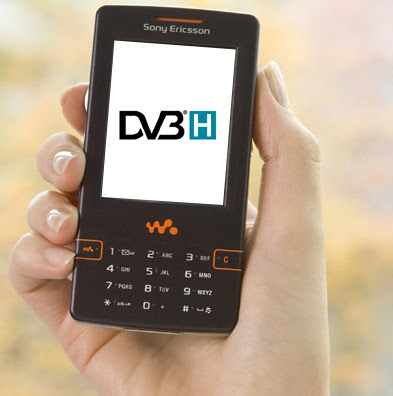
 Nokia N96 with Mobile TV capability (DVB-H) has recently been launched in UK but there is no one broadcasting any Mobile TV. Maybe the operators are hoping that once there are enough handsets with this capability, Mobile TV can be launched and hopefully people will view it.
Last month, Juniper Research released a report likely to strike fear in the hearts of operators betting on consumers’ willingness to pay for mobile TV content. In “Opportunities for Streamed & Broadcast Services, 2008-2013,” Juniper projects that by 2013 some 330 million people worldwide will have handsets that can receive analog and digital broadcast TV signals — but less than 14 percent of them will sign up for pay mobile TV services.
“The development of terrestrial TV-capable receivers with comparatively low power consumption, and the availability of these receivers in mass market handsets, throws into question the business case for the deployment of a dedicated network in many markets,” said report author Dr. Windsor Holden.
In Germany, Mobile 3.0′s DVB-H trial flopped when operators started promoting their own TV-capable phones designed to receive DVB-T signals for free — undermining Mobile 3.0’s pay TV business model.
Last July, Toshiba shut down its Japanese satellite mobile TV subsidiary, Mobile Broadcasting, because the subscriber base wasn’t big enough to support the business. But it wasn’t because the Japanese aren’t watching mobile TV. In fact, shipments of handsets able to receive Japan’s free 1-seg mobile TV service continue to soar according to the Japan Electronics Information Technology Association — 10 million in the first half of 2008, bringing the total of 1-seg units shipped to 30 million.
Of course, the situation is markedly different in the United States where carriers have a lock on the handsets available to subscribers. And so far, that has effectively stifled competition from devices that can receive free-to-air TV. But with more free-to-air devices hitting the market, it’s reasonable to question whether that trend will continue indefinitely.
In another announcement last month, IHT reported that France presented plans to set aside about a fifth of the country’s prime television broadcasting spectrum for mobile Internet and television services by the end of 2009, in what supporters described as a major step toward creating a harmonized mobile broadband network in Europe.
France is the first major European country to reserve part of its most valuable broadcasting spectrum, the so-called UHF band, for mobile broadband and video services. Finland and Sweden have also said they plan to reserve the band for mobile services.
If a Europewide broadband network were to come to fruition, its greater scale would probably push down the cost of Internet services to consumers, especially in rural areas not reached by fast, fixed-line networks. It could also enable large mobile operators to sell services, like mobile TV or mobile broadband, across national borders, further increasing competition and lowering consumer prices.
The move was hailed by mobile operators and by the European Union’s telecommunications commissioner, Viviane Reding, who is proposing that her office be given a greater role in influencing how EU countries redistribute the frequency.
The French plan, disclosed by Eric Besson, a French state secretary responsible for evaluation of public policies, commits France to reserving 72 megahertz of prime spectrum that is currently being used exclusively by television broadcasters – the 790 MHz to 862 MHz band – for mobile broadband services by the end of next year.
Besson said the country’s broadcasters would be able to use the remaining portion of the UHF spectrum – 470 MHz to 790 MHz. He said that would still be enough to support 11 terrestrial broadcasters plus two new mobile TV broadcasters, owned either by mobile operators or TV broadcasters.
Sami said the French plan would most likely influence other European nations to make a similar redistribution. Britain, he said, is also leaning toward devoting a portion of that spectrum, from 806 MHz to 862 MHz, for mobile services.
In Germany, DVB-H licensee Mobile 3.0 handed back its licence to local regulators. The return of the licence was ordered by the authority for private broadcasters – Zulassungs- und Aufsichtskommission für den privaten Rundfunk (ZAK) – because Mobile 3.0 did not meet the conditions of the licence. It is not sure when a new licence will be issued. Meanwhile DVB-T carries on its success with LG planning to launch another handset model before Christmas.
In Switzerland, Take-up of the mobile TV service from Swisscom is not meeting expectations, according to Swisscom Broadcast chief Jean-Paul de Weck, speaking during the Biel Bienne Communication Days (Comdays). The main reason for the slow acceptance is the lack of choice of DVB-H capable handsets. Up until the end of September, the Nokia N77 was the only handset available to receive the service, though now there are four different models. Swisscom currently has about 5,000 mobile TV users, though it expects to gain more subscribers with the wider choice of handsets.
Qualcomm is now to give some more attention to its mobile TV standard of MediaFLO. This is because they no longer have to worry about UMB (
see this). Outlining future strategies,
Qualcomm indicated it’s focusing more on its MediaFLO mobile broadcast TV and its Firethorn mobile banking technologies to carry it in the near term while it develops its Long Term Evolution (LTE) wireless infrastructure and its Snapdragon platform for future inroads in wireless mobile. MediaFLO is operated in 62 markets, but it’s expected to get a boost in February when the big switchover to digital TV takes place. Qualcomm purchased $555 million worth of spectrum in the FCC’s 700-MHz auction earlier this year, and the purchase will be used to spread MediaFLO. The new spectrum will enable the company to address 108 markets by the end of 2009, according to media reports.
A large U.S. television broadcaster has announced good results from recent trials in Chicago and Denver of mobile TV using a draft standard from the Advanced Television Systems Committee (ATSC). Ion Media Networks, Inc. said it found it relatively easy to set up two mobile channels in each city and reception was better than expected. The Open Mobile Video Coalition (OMVC), an alliance of local and national TV broadcasters, hopes to see members roll out commercial mobile TV services late next year. To date mobile TV services using other technologies have failed to deliver and grow a market among cellphone, notebook and car video users.
Ion Media’s stations WCPX and KPXC have been multicasting two standard definition mobile channels since August. LG Electronics and Harris Corp., whose technology was selected for the ATSC standard, provided prototype mobile TV receivers and transmission equipment for the tests.
We’re seeing fantastic reception out to as far as 40 miles from transmitters, and beyond that we have good transmission outdoors but it’s not consistent indoors,” reported Jenkins.
Reception was also good in cars at freeway speeds and indoors within 40 miles of transmitters. “We went into parking garages where there were three or four levels of concrete above us, and reception was perfect–that was one of the big technical lessons,” said Jenkins.
Spectrum availability was not a problem in the trial. One station in the trial supports an existing high definition terrestrial broadcast, another supports multiple existing standard def channels.
Incoming search terms for the article:
Tags: again getting attention, Air Tv, ATTENTION MOBILE TV, Broadcast Services, Broadcast Tv, Capable Phones, Dedicated Network, Digital Broadcast, Germany Mobile, getting some attention again, Information Technology Association, Japan Electronics, jean-paul de Weck, mobile broadcast TV services juniper, mobile tv capable handsets models, mobile-tv, Nokia Dvb, nokia-n96, Own Tv, pay uhf mobil tv, Power Consumption, Report Author, Subscriber Base, Terrestrial Tv, Tv Content, Tv Signals, Windsor Holden, www laptop paymobiletv com
[#3: Edit Options>MightyAdsense>Adsense Code]
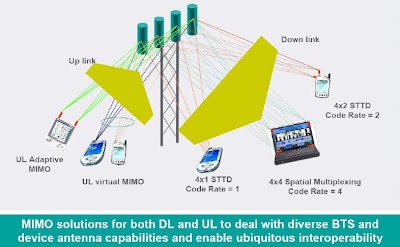
MIMO (Multiple Input Multiple Output) by definition requires multiple antenna but it is also possible to use one antenna with Co-operative Diversity to create Cooperative MIMO or Virtual MIMO.
Earlier this year, Nokia Siemens Network reported the following on Virtual MIMO:
Researchers at Nokia Siemens Networks have demonstrated in lab conditions how a virtual Multiple Input Multiple Output (MIMO) technique can be used for the uplink in LTE (Long Term Evolution) networks.
Tests at its labs in Munich, Germany, have shown how, using such an SDMA (Space Division Multiple Access) based technique, two standard mobile devices, each with only one physical transmission antenna, can communicate with a base station simultaneously and on the same radio channel.
On the uplink transmission, data rates of 108Mbit/s were achieved, double the usual speed, while the downlink managed 160Mbit/s.
The researchers say that while MIMO on the downlink primarily generates higher peak data rates for the end user, virtual MIMO on the uplink makes it possible for an operator to increase network capacity and better utilize the available spectrum.
Nokia Siemens also said the technique contributes to one of the crucial prerequisites for the success of LTE by reducing power consumption of LTE based devices to “acceptable levels” even when used for very high data-intensive applications and that this should be achieved at “moderate prices.”
The researchers say that with virtual MIMO only one power amplifier and transmission antenna is necessary for each device, contributing to reduced production costs and power needs.
In the LTE test bed, developed and built in collaboration with the Fraunhofer Institute for Telecommunications (Heinrich Hertz Institute), two co-operating end-user devices form a virtual MIMO system in which the antenna elements are distributed over the two devices. The two devices can be supplied simultaneously with data over the same frequency band using space division multiplexing.
The following is an extract from EURASIP Journal onWireless Communications and Networking:
Multihop relaying technology is a promising solution for future cellular and ad hoc wireless communications systems in order to achieve broader coverage and to mitigate wireless channels impairment without the need to use high power at the transmitter.
Recently, a new concept that is being actively studied in multihop-augmented networks is multiuser cooperativediversity, where several terminals forma kind of coalition to assist each other with the transmission of their messages.
In general, cooperative relaying systems have a source node multicasting a message to a number of cooperative relays, which in turn resend a processed version to the intended destination node. The destination node combines the signal received from the relays, possibly also taking into account the source’s original signal.
Cooperative diversity exploits two fundamentals features of wireless medium: its broadcast nature and its ability to achieve diversity through independent channels.
There are three advantages from this:
(1) Diversity. This occurs because different paths are likely to fade independently. The impact of this is expected to be seen in the physical layer, in the design of a receiver that can exploit this diversity.
(2) Beamforming gain. The use of directed beams should improve the capacity on the individual wireless links.The gains may be particularly significant if space-time coding schemes are used.
(3) Interference mitigation. A protocol that takes advantage of the wireless channel and the antennas and receivers available could achieve a substantial gain in system throughput by optimizing the processing done inthe cooperative relays and in the scheduling of retransmissions by the relays so as to minimize mutual interference and facilitate information transmission by cooperation.
Source: Multiuser Cooperative Diversity forWireless Networks by George K. Karagiannidis, Chintha Tellambura, Sayandev Mukherjee and Abraham O. Fapojuwo, Volume 2006, Article ID 17202
Decode and Forward
Simple and adaptable to channel condition (power allocation)
If detection in relay node unsuccessful => detrimental for detection in receiver (adaptive algorithm can fix the problem)
Receiver need CSI between source and relay for optimum decoding
Amplify and Forward
Achieve full diversity
Performance better than direct transmission and decode-and-forward
achieve the capacity when number of relays tend to infinity
Coded Cooperation
transmit incremental redundancy for partner
Automatic manage through code design
no feedback required between the source and relay
Rely on full decoding at the relay => cannot achieve full diversity!
Not scalable to large cooperating groups.
Incoming search terms for the article:
Tags: 3gpp cooperative diversity, 3gpp virtual mimo, 3gpp Virtual MIMO broadcast, Acceptable Levels, adaptive signal processing mimo cooperative diversity, Antenna Elements, antennas diversity multi user interference, broadcast capacity in virtual mimo, co mimo, coded cooperation MIMO, cooperation slide multi user, cooperative coding LTE, Cooperative Diversity, cooperative diversity interference, cooperative diversity lte-advanced, cooperative diversity multihop 2008 or 2009 or 2010, cooperative diversity slides, cooperative MIMO channel, Cooperative MIMO in LTE-A, cooperative MIMO MULTIUSER TECHNIQUES, cooperative mimo relaying, cooperative network mimo, cooperative relay, definition diversity MIMO, definition of Virtual Antenna mapping, difference between mimo and cooperation, difference between virtual MIMO and cooperative MIMO, difference cooperative mimo virtual mimo cooperative communication, diversity definition in mimo, diversity mimo interference multiuser, downlink, feedback channel virtual mimo, Fraunhofer Institute For Telecommunications, Fraunhofer Institute for Telecommunications virtual mimo, fraunhofer virtual mimo, Frequency Band, geoge tech mimo ad hoc, Heinrich Hertz Institute, hotspot MIMO microcell interference, hts, HTS MULTIUSER, Intensive Applications, interference mitigation in cooperative mimo, ipad 3g multiuser, Iphone 3G with MIMO, is virtual MIMO coopeartive communication, lte cooperative relaying, LTE cooperative transmissions, LTE MIMO, LTE multi user diversity, lte multiuser MIMO, LTE relay MIMO, LTE Uplink Multi user MIMO, LTE uplink receiver, lte virtual mimo, MIMO 3g hotspots, mimo 3g wireless communication technology report, MIMO cooperative diversity, MIMO cooperative relay network, MIMO lab, MIMO multihop relay, mimo multiuser detection, mimo virtual antenna mapping, mobile cooperative diversity using users, mobile phone virtual MIMO, Moderate Prices, multi antenna relay, Multi User Capacity in Cooperative Network, multi user mimo lte, multi-user cooperative diversity, Multi-user cooperative mimo, multi-user diversity meaning, multiuser cooperativediversity, multiuser detection in cooperative MIMO relay, multiuser diversity definition, Munich Germany, nokia-siemens-networks, NSN Virtual Aantenna Mapping, Peak Data, Physical Transmission, Power Amplifier, Power Consumption, Radio Channel, relay channel mimo virtual, slide cooperative relaying, Space Division, Space-Time for MIMO Multicasting and Full-Rate Full-Diversity Codes with Partial CSI, t, technology virtual necklace phone, Term Evolution, Transmission Antenna, Transmission Data, type of antenna diversity of iphone 3gs, uplink virtual mimo in LTE, verizon mimo 3g store, virtual antenna mapping, Virtual Antenna Mapping mimo, virtual antenna mapping NSN, virtual cooperative relay network, virtual mimo, virtual mimo android, virtual mimo cooperative, virtual MIMO cooperative relay, virtual mimo is, virtual MIMO lte, virtual MIMO multiuser diversity, Virtual MIMO multiuser relay, virtual mimo nokia, virtual mimo physical, virtual mimo relay, virtual MIMO technology co-operate, virtual multi antenna, vitual mimo, what is cooperative mimo, what is virtual mimo, which type of channel is used in MIMO Definition
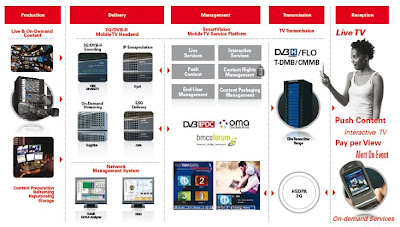
Brussels has now officially endorsed DVB-H as the mobile TV technology of choice in Europe. This means that member states are now required to “encourage” use of the technology, though the commission has no advice as to how to encourage punters to tune in.
In the UK both T-Mobile and Orange are about to launch trials using the competing MBMS (Multimedia Broadcast Multicast Service) technology, which utilises existing 3G networks and spectrum. The technology for that trial is being provided by NextWave Wireless, and CMO Jon Hambidge is dismissive of EU attempts to mandate a mobile TV technology “when [the network operators] spent billions of dollars on their licences MBMS [was] part of that business case”.
Note that in an earlier blog I had mentioned that Mobile TV and MBMS will co-exist. See here.
Viviane Reding, EU telecoms commissioner,
has made it clear that if companies don’t migrate to DVB-H she’ll use
regulatory measures to create an EU-wide standard.
Background Material:
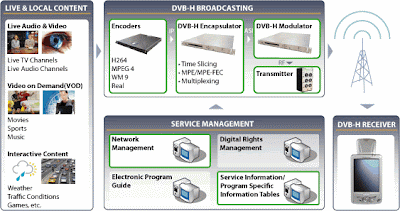
The DVB-H standard is a recent extension of the DVB-T standard. It is intended to allow reception of television programs with portable and mobile terminals of relatively small size (the H of DVB-H means “handheld,” which indicates the primary type of devices targeted).
In most cases, the terminal will be a mobile phone. In fact, one of the
main goals of DVB-H is to avoid the limitation inherent to UMTS of the number of terminals which can receive the same broadcast
television program at one time. The main extensions of DVB-H compared to DVB-T are as follows (their use is signaled by specific TPS bits):
• addition of a 4 k COFDM mode, better suited to the implementation of SFN networks of medium cell size and allowing a reduction of the power consumption of the terminal compared to the 8 k mode;
• addition of a longer time interleaving (double for the 4 k mode and quadruple for the 2 k mode), which improves the behavior in case of signal fading and resistance to impulsive noise;
• transmission of a given service in periodic bursts by a process known as “time slicing” which permits a subscriber to activate the receiver only during a fraction of the time (5 to 10%) in order to reduce the power consumption, thus increasing the battery operating time;
• the ability to increase robustness by means of an optional additional link layer error correction (MPE-FEC) to improve the reception with an integrated antenna of necessarily very limited performances.
In order to allow the best use of these extensions, TV programs or other broadcast services are transmitted to mobile terminals as elementary streams (ES) formatted as IP (Internet Protocol) datagrams. The use of the IP protocol is, however, different from the one in TV by ADSL using DVB-IP: in DVB-H, the IP datagrams are encapsulated according to the so-called multiprotocol encapsulation (MPE) and then inserted in an MPEG-2 transport stream for transmission (in DVB-IP, it’s the transport stream which is IP encapsulated). This operation consists of encapsultaing the IP datagrams in DSM-CC sections by adding a header and a CRC termination. These sections are then segmented into MPEG-2 transport packets.
In order to realize the desired time-slicing, sections are not transmitted immediately, but are accumulated in order to form records of a maximum size of 191 kb, which will correspond to the duration of the time slice allocated to a service. These records can be represented as a table of 191 colums by a maximum of 1024 rows on which an optional additional error correction called “MPE-FEC” can be applied. This MPE-FEC consists of a Reed–Solomon coding RS (255,191) applied to words of 191 bytes made of the lines of this table. This will produce a second table made of an RS word of 64 bytes for each line of the original table. The result will be a new table of 255 colums by a maximum of 1024 lines which will be read column by column for transmission.
The DVB-H standard can be used in the UHF TV band with usual DVB-T channel widths (6, 7, or 8 MHz, depending on the region) or in other frequency bands (e.g., L-band in the United States around 1.67GHz with other channel widths, 5MHz in this case).
One of the problems with the use of the UHF band for TV reception in a GSM phone is the proximity of the high part of the UHF band (up to 862 MHz) to the GSM 900 transmit band of the terminal (880 to 915 MHz). Taking into account the current filtering capabilities, this prevents in practice the possibility of using the high UHF channels (>750 MHz) in a TV receiver integrated into an operating GSM phone.
The DVB-H standard can in principle use all the combinations of modulation parameters allowed by the standard (QPSK to 64-QAM, etc.) but, given the required robustness of this application, in practice only QPSK and 16-QAM with FEC of 1/2 or 2/3 are realistically usable, which permits bit-rates of 5 to 11 Mb/s in an 8MHz channel (without MPE-FEC correction). The video encoding used will be mainly H.264 with a CIF or QCIF resolution and bit-rates in the order of 256 to 384 kb/s.
Various experiments took place in Europe from 2004 onward to test the technical performances of the system in order to define the characteristics of the network, and to find out the user acceptance and expectations in order to establish a viable business model. The reactions of the test sample have been positive or enthusiastic everywhere. The first commercial DVB-H services started in Finland and Italy in mid-2006.
For more information see:
Tags: 3g-networks, Background Material, Broadcast Television, Case Note, Cofdm, Impulsive Noise, Main Goals, Mbms, Mobile Terminals, mobile-tv, Network Operators, Nextwave Wireless, Power Consumption, Reding, Regulatory Measures, Service Technology, T Mobile, Television Program, Television Programs, Tv Technology
Before we start, I have to confess that I made up LED-Fi. I was thinking more of LiFi but there is already a LiFi technology from Panasonic (not al all related ti this one though).
 According to a post in cellular news, Lightbulbs Could Replace Wi-Fi Hotpsots in future:
Boston University’s College of Engineering is launching a program, under a National Science Foundation grant, to develop the next generation of wireless communications technology based on visible light instead of radio waves. Researchers expect to piggyback data communications capabilities on low-power light emitting diodes, or LEDs, to create “Smart Lighting” that would be faster and more secure than current network technology.
This initiative aims to develop an optical communication technology that would make an LED light the equivalent of a Wi-Fi access point.
“Imagine if your computer, iPhone, TV, radio and thermostat could all communicate with you when you walked in a room just by flipping the wall light switch and without the usual cluster of wires,” said BU Engineering Professor Thomas Little. “This could be done with an LED-based communications network that also provides light – all over existing power lines with low power consumption, high reliability and no electromagnetic interference. Ultimately, the system is expected to be applicable from existing illumination devices, like swapping light bulbs for LEDs.”
Little envisions indoor optical wireless communications systems that use white LED lighting within a room – akin to the television remote control device – to provide Internet connections to computers, personal digital assistants, television and radio reception, telephone connections and thermostat temperature control.
With widespread LED lighting, a vast network of light-based communication is possible, Little noted. A wireless device within sight of an enabled LED could send and receive data though the air – initially at speeds in the 1 to 10 megabit per second range – with each LED serving as an access point to the network. Such a network would have the potential to offer users greater bandwidth than current RF technology.
Moreover, since this white light does not penetrate opaque surfaces such as walls, there is a higher level of security, as eavesdropping is not possible. LED lights also consume far less energy than RF technology, offering the opportunity to build a communication network without added energy costs and reducing carbon emissions over the long term.
The ability to rapidly turn LED lights on and off – so fast the change is imperceptible to the human eye – is key to the technology. Flickering light in patterns enables data transmission without any noticeable change in room lighting. And the technology is not limited to indoor lights; its first real test may very well come outdoors, in the automotive industry.
I can understand how the downlink would work but not sure how uplink data transfer would work.
Similar technology using Light Bulbs has been available for some time. See
this and
this.
Incoming search terms for the article:
Tags: Boston University, Boston University’s College of Engineering led, Communications Capabilities, Electromagnetic Interference, is 3G phone based on optical communication, LED FI, LED Hotspots, led light for wireless communication tech review, led light instead of wifi, Led Lighting, LED lighting data downlink, led lighting data network, led replace wifi, led replacement for wifi, LED replaces wifi, li fi 3g to wifi, Lifi, Light Bulbs, Light Emitting Diodes, National Science Foundation, next replacement for wifi, Next-generation LED lightbulbs could replace WiFi – Optical wireless networks, Optical Communication Technology, Optical hotspots speed up wireless communication, Optical Wireless Communications, Personal Digital Assistants, Power Consumption, radio-waves, replacement for wifi, Smart Lighting, Television Remote Control, Temperature Wifi, Thermostat Temperature, white led data transmission, Wi Fi Access, Wi Fi Access Point, Wireless Communications Systems, Wireless Communications Technology


 Picked this up from Martin’s Blog. One of the things that has been left undefined are the end user applications. Unlike GSM and 3G+ where AMR RAB’s has been defined for CS voice calls, there is no provision in LTE. In fact we know that CS domain is completely absent and only IP based PS domain is present. It has been assumed that IMS will be de-facto present along with LTE and the architecture rightly defines so but there is nothing stopping LTE being deployed without IMS. The following is from Martin’s Blog:
 Nokia N96 with Mobile TV capability (DVB-H) has recently been launched in UK but there is no one broadcasting any Mobile TV. Maybe the operators are hoping that once there are enough handsets with this capability, Mobile TV can be launched and hopefully people will view it.

 There are 3 main types of co-operative diversity which are self-explanatory in the diagram above:


 According to a post in cellular news, Lightbulbs Could Replace Wi-Fi Hotpsots in future:
 Powered by WordPress ·