
While going through
September issue of
IEEE Communications magazine, I came across Multihop Cellular Networks (MCNs). The concept sounded familiar and another article confirmed my suspicion. MCNs is similar to ODMA for those who remember the early
3GPP specs. ODMA or Opportunity Driven Multiple Access was revolutionary concept but it was too advanced for that time and the chipset (and battery) technology was not that advanced to have it implemented successfully.
So what exactly is multihop cellular network (MCN)?
MCN incorporates the flexibility of ad hoc networking, while preserving the benefits of using an infrastructure.
The salient feature of MCN is that communications are not restricted to single hop; multihop transmissions are allowed.
The advantages of using MCN include capacity enhancement, coverage extension, network scalability, and power reduction. However, there are still a number of open research issues that need to be solved in order to provide efficient and effective multihop transmissions in cellular networks in the future.
From another article in the same issue:
Existing architectures and protocols proposed for MCNs are very diverse and different in several aspects. Relay Stations (RSs) can be preinstalled by network operators or simply be other idle MHs who are not transmitting their own data. Also, depending on how radio resources are allocated for routing paths of active connections, different protocols at the medium access control and routing layers can be designed. Radio resources forMobile Hosts (MHs) at different hops may be allocated in timedivision duplex (TDD) or frequency-divisionduplex (FDD) mode. Frequency bands other than the cellular frequency band may be used for relaying. Finally, advanced techniques using cooperative diversity can be employed to enhance network performance compared to simple relaying schemes.
Tags: 3gpp, Battery Technology, Capacity Enhancement, Cellular Frequency, Cellular Network, cellular-networks, Cooperative Diversity, Frequency Band, Frequency Bands, Ieee Communications Magazine, Mcn, Medium Access Control, Mode Frequency, Network Scalability, Odma, Radio Resources, Relay Stations, Revolutionary Concept, Salient Feature, September Issue
[#2: Edit Options>MightyAdsense>Adsense Code]
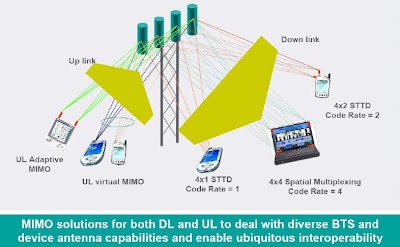
MIMO (Multiple Input Multiple Output) by definition requires multiple antenna but it is also possible to use one antenna with Co-operative Diversity to create Cooperative MIMO or Virtual MIMO.
Earlier this year, Nokia Siemens Network reported the following on Virtual MIMO:
Researchers at Nokia Siemens Networks have demonstrated in lab conditions how a virtual Multiple Input Multiple Output (MIMO) technique can be used for the uplink in LTE (Long Term Evolution) networks.
Tests at its labs in Munich, Germany, have shown how, using such an SDMA (Space Division Multiple Access) based technique, two standard mobile devices, each with only one physical transmission antenna, can communicate with a base station simultaneously and on the same radio channel.
On the uplink transmission, data rates of 108Mbit/s were achieved, double the usual speed, while the downlink managed 160Mbit/s.
The researchers say that while MIMO on the downlink primarily generates higher peak data rates for the end user, virtual MIMO on the uplink makes it possible for an operator to increase network capacity and better utilize the available spectrum.
Nokia Siemens also said the technique contributes to one of the crucial prerequisites for the success of LTE by reducing power consumption of LTE based devices to “acceptable levels” even when used for very high data-intensive applications and that this should be achieved at “moderate prices.”
The researchers say that with virtual MIMO only one power amplifier and transmission antenna is necessary for each device, contributing to reduced production costs and power needs.
In the LTE test bed, developed and built in collaboration with the Fraunhofer Institute for Telecommunications (Heinrich Hertz Institute), two co-operating end-user devices form a virtual MIMO system in which the antenna elements are distributed over the two devices. The two devices can be supplied simultaneously with data over the same frequency band using space division multiplexing.
The following is an extract from EURASIP Journal onWireless Communications and Networking:
Multihop relaying technology is a promising solution for future cellular and ad hoc wireless communications systems in order to achieve broader coverage and to mitigate wireless channels impairment without the need to use high power at the transmitter.
Recently, a new concept that is being actively studied in multihop-augmented networks is multiuser cooperativediversity, where several terminals forma kind of coalition to assist each other with the transmission of their messages.
In general, cooperative relaying systems have a source node multicasting a message to a number of cooperative relays, which in turn resend a processed version to the intended destination node. The destination node combines the signal received from the relays, possibly also taking into account the source’s original signal.
Cooperative diversity exploits two fundamentals features of wireless medium: its broadcast nature and its ability to achieve diversity through independent channels.
There are three advantages from this:
(1) Diversity. This occurs because different paths are likely to fade independently. The impact of this is expected to be seen in the physical layer, in the design of a receiver that can exploit this diversity.
(2) Beamforming gain. The use of directed beams should improve the capacity on the individual wireless links.The gains may be particularly significant if space-time coding schemes are used.
(3) Interference mitigation. A protocol that takes advantage of the wireless channel and the antennas and receivers available could achieve a substantial gain in system throughput by optimizing the processing done inthe cooperative relays and in the scheduling of retransmissions by the relays so as to minimize mutual interference and facilitate information transmission by cooperation.
Source: Multiuser Cooperative Diversity forWireless Networks by George K. Karagiannidis, Chintha Tellambura, Sayandev Mukherjee and Abraham O. Fapojuwo, Volume 2006, Article ID 17202
Decode and Forward
Simple and adaptable to channel condition (power allocation)
If detection in relay node unsuccessful => detrimental for detection in receiver (adaptive algorithm can fix the problem)
Receiver need CSI between source and relay for optimum decoding
Amplify and Forward
Achieve full diversity
Performance better than direct transmission and decode-and-forward
achieve the capacity when number of relays tend to infinity
Coded Cooperation
transmit incremental redundancy for partner
Automatic manage through code design
no feedback required between the source and relay
Rely on full decoding at the relay => cannot achieve full diversity!
Not scalable to large cooperating groups.
Incoming search terms for the article:
Tags: 3gpp cooperative diversity, 3gpp virtual mimo, 3gpp Virtual MIMO broadcast, Acceptable Levels, adaptive signal processing mimo cooperative diversity, Antenna Elements, antennas diversity multi user interference, broadcast capacity in virtual mimo, co mimo, coded cooperation MIMO, cooperation slide multi user, cooperative coding LTE, Cooperative Diversity, cooperative diversity interference, cooperative diversity lte-advanced, cooperative diversity multihop 2008 or 2009 or 2010, cooperative diversity slides, cooperative MIMO channel, Cooperative MIMO in LTE-A, cooperative MIMO MULTIUSER TECHNIQUES, cooperative mimo relaying, cooperative network mimo, cooperative relay, definition diversity MIMO, definition of Virtual Antenna mapping, difference between mimo and cooperation, difference between virtual MIMO and cooperative MIMO, difference cooperative mimo virtual mimo cooperative communication, diversity definition in mimo, diversity mimo interference multiuser, downlink, feedback channel virtual mimo, Fraunhofer Institute For Telecommunications, Fraunhofer Institute for Telecommunications virtual mimo, fraunhofer virtual mimo, Frequency Band, geoge tech mimo ad hoc, Heinrich Hertz Institute, hotspot MIMO microcell interference, hts, HTS MULTIUSER, Intensive Applications, interference mitigation in cooperative mimo, ipad 3g multiuser, Iphone 3G with MIMO, is virtual MIMO coopeartive communication, lte cooperative relaying, LTE cooperative transmissions, LTE MIMO, LTE multi user diversity, lte multiuser MIMO, LTE relay MIMO, LTE Uplink Multi user MIMO, LTE uplink receiver, lte virtual mimo, MIMO 3g hotspots, mimo 3g wireless communication technology report, MIMO cooperative diversity, MIMO cooperative relay network, MIMO lab, MIMO multihop relay, mimo multiuser detection, mimo virtual antenna mapping, mobile cooperative diversity using users, mobile phone virtual MIMO, Moderate Prices, multi antenna relay, Multi User Capacity in Cooperative Network, multi user mimo lte, multi-user cooperative diversity, Multi-user cooperative mimo, multi-user diversity meaning, multiuser cooperativediversity, multiuser detection in cooperative MIMO relay, multiuser diversity definition, Munich Germany, nokia-siemens-networks, NSN Virtual Aantenna Mapping, Peak Data, Physical Transmission, Power Amplifier, Power Consumption, Radio Channel, relay channel mimo virtual, slide cooperative relaying, Space Division, Space-Time for MIMO Multicasting and Full-Rate Full-Diversity Codes with Partial CSI, t, technology virtual necklace phone, Term Evolution, Transmission Antenna, Transmission Data, type of antenna diversity of iphone 3gs, uplink virtual mimo in LTE, verizon mimo 3g store, virtual antenna mapping, Virtual Antenna Mapping mimo, virtual antenna mapping NSN, virtual cooperative relay network, virtual mimo, virtual mimo android, virtual mimo cooperative, virtual MIMO cooperative relay, virtual mimo is, virtual MIMO lte, virtual MIMO multiuser diversity, Virtual MIMO multiuser relay, virtual mimo nokia, virtual mimo physical, virtual mimo relay, virtual MIMO technology co-operate, virtual multi antenna, vitual mimo, what is cooperative mimo, what is virtual mimo, which type of channel is used in MIMO Definition


 There are 3 main types of co-operative diversity which are self-explanatory in the diagram above:
 Powered by WordPress ·