Orange UK has partnered with Universal Music and 4Music (a derivative of the terrestrial TV Channel 4), to launch a free streaming music service for new tariff called ‘Monkey’. The tariff is for prepay customers, which makes the whole data consumption angle more interesting (prepay users are not usually looked after in terms of data usage!).
Users will be able to both create and share playlists on the web, and somewhat unsurprisingly will be sent Mobile Ads too. Luckily, as the ‘yoof’ market (which this tariff is squarely aimed at) is apparently accepting of this kind of thing, it should be no problem.
You’ll be able to get a bit of Monkey in Orange stores and Phones4U stores now, and then from September in other channels. Channel 4 will be doing its bit and promo-ing things across its various TV and Web properties.
Clearly Orange is aiming to target users who perhaps don’t have the high-tier smartphone-type handsets, and those who are unable to consume existing pay-for music services – so it’s going to be interesting to see how popular this is, and how it plays out. I wonder if Orange will release usage stats some months down the line?
Incoming search terms for the article:
Tags: 3g streaming on orange, 3g technology and music streaming, Consumption, cost of streaming iphone orange 2010, Derivative, f, Free Music, Free Streaming Music, handsets, how do i store music on my mobile from orange monkey, how to download music on monkey tariff, ipad uk 3g tarriff, ipad uk tarrif, iPhone monkey tariff, iphone stream music, Launch Music, Mobile Ads, Monkey, monkey from orange iPhone, monkey music store by orange, monkey orange music review, monkey tariff, monkey tariff orange iphone, music in tariff orange, Music Service, Music Services, orange monkey music iphone, orange monkey music service, orange monkey price tariff, orange monkey tariff review, Orange UK Monkey advertising, Orange uk music monkey, orange-uk, streaming music iphone orange, streaming music tarrif, streaming on orange uk, Tariff, Terrestrial Tv, Tv Channel, Uk Music, Universal Music, Usage Stats, vodafone music streaming service uk, Web Properties
[#2: Edit Options>MightyAdsense>Adsense Code]
 Discussions are again resurfacing about which technology should be used to improve coverage; Femtocells or UMA. Honestly, I have not been a big supporter of UMA (and you dont have to agree with me) and earlier this year when Nokia raised doubts about the technology, i stopped following it completely. Kineto has been the biggest supporter of UMA and is still carrying the torch.
Kineto recently
received over $15 million in investment from Motorola that it plans to use to increase its reach in UMA. Last month it had received
investment from NEC. One of the reasons for the resurgence could be because the UMA technology has matured since being used for some time. T-Mobile has already rolled
Hotspot @ Home using UMA. Also more phones are now available supporting UMA.
One of the drawbacks that will always be present in case of UMA is that special
handsets will be required that would support WiFi as
UMA is based on 802.11. This means more expensive phones and higher
consumption of power leading to smaller battery lives. One more problem with UMA is the interference due to other
ISM band devices and there are many technologies like Bluetooth, etc that are competing for the band.
The
drawback in case of Femtocells could be that their price is still quite high as complete Node B + RNC functionality is generally available in a Femtocell and at the same time all the aspects have not yet been standardised. Along with these,
Femtocells that use the same spectrum as that of the operator can cause interference with the Macro cell. This would in turn require very clever management of spectrum frequencies, etc.
A possible long term solution could be (but I dont see anyone agreeing to it right now) that phones with UMA technology become more common and a combined UMA + Femtocell equipment is rolled out by the operator. At the end user premises, depending on the strength of rf reception, the equipment can either use UMA or normal Femtocell functionality. If this idea is agreed upon, then there would still be couple of years before all interworking and other technological problems are ironed out.
Incoming search terms for the article:
Tags: 3G UMA vs femtocell, BLUETOOTH INTERFERENCE FEMTOCELL, Carrying The Torch, Clever Management, Consumption, does o2 have uma or a femtocell ?, doubts, Drawback, drawback femtocell, drawbacks of femto cells, femto uma, femto vs uma, femtocell, femtocell and uma, femtocell drawbacks, femtocell hacking, femtocell ism, femtocell or uma, femtocell UMA technologies, femtocell vs uma, femtocells, femtocells uma, Femtocells unlocked, handsets, how to hack uma on the iphone, Interference, iphone uma 3gpp femtocell, Ism Band, Kineto, Long Term Solution, Macro Cell, nexus one kineto, Node, o2 uma, o2 uma technology, Premises, Resurgence, Rf, Rnc, samsung epic uma, T Mobile, Time T, tmobile femtocell 2010, tmobile uma femtocell, uma technology iphone, uma vs femtocell, unlocked femtocell, unlocked uma
[#3: Edit Options>MightyAdsense>Adsense Code]
 Fractional DPCH was added in Rel-6 to optimise the consumption of downlink channelization codes. When using HS-DSCH (High Speed Downlink Shared Channel), the main use for DL DPCH (also known as A-DPCH where A stands for Associated) is to carry power control commands (TPC bits) to the UE in order to adjust the uplink transmission. If all RBs (Radio Bearers) including SRBs (Signalling Radio Bearers) are mapped on to HS-DSCH then the DL codes are being wasted. SF 256 is used for A-DPCH and so every code being used by a user is seriously depleting the codes available for other UE’s. To overcome this F-DPCH is used so that multiple UE’s can share a single DL channelisation code. The limitation is 10 UEs in Rel-6.
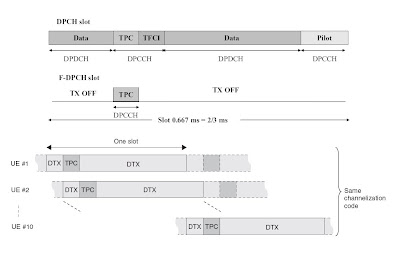
For several users, the network configures each user having the same code but different frame timing and, thus, users can be transmitted on the single code source. The original timing is thus retained which avoids the need to adjust timings based on Release 99 power control loop implementation.
During slots where the DPCCH is not transmitted, the NodeB cannot estimate the uplink signal-to-interference ratio for power-control purposes and there is no reason for transmitting a power control bit in the downlink. Consequently, the UE shall not receive any power control commands on the F-DPCH in downlink slots corresponding to inactive uplink DPCCH slots.
There are some restrictions for FDPCH. It is not usable with services requiring data to be mapped to the DCH, such as AMR speech calls and CS video. Also, the lack of pilot information means that a method like feedback-based transmit diversity (closed loop mode) is not usable. The use of closed loop diversity is based on user-specific phase modification, wherein pilot symbols would be needed for verification of the phase rotation applied. On the other hand, when utilizing the F-DPCH, SRBs can benefit from high data rates of HSDPA and reduce service setup times remarkably
Finally, as you may have already figured out, by using F-DPCH the cell capacity has been improved and at the same time for same number of users, the interference has gone down significantly.
In Release 7, Rel-6 limitation has been removed. In R6, for a given UE in soft handover the TPC from all F-DPCH had to have the same offset timing. In R7, F-DPCH (TPC bits) can have different timing from different cells. This is possible due to introduction of 9 new F-DPCH slot formats (slot format 0 is the legacy F-DPCH slot format). The RRC signalling is done seperately for slot formats from the RNC to each of the cells.
You may also be interested in this Ericsson paper titled “The effect of F-DPCH on VoIP over HSDPA Capacity”. Available
here.
Incoming search terms for the article:
Tags: 3g dpch, 3g DPCH power offset, 3G F-DPCH, 3G F-DPCH timing, 3g fractional DPCH, 3gpp f-dpch slot format, A-DCH F-DPCH, A-DCHとは, a-dpch, Amr, capacity per cell UMTS HSDPA F-DPCH, channelisation code f-dpch, Consumption, Control Bit, Control Loop, Control Purposes, CPC F-DPCH, Dch, Diversity, DL DPCH, DL F-DPCH, DL Slot format and NodeB, Downlink Slots, dpch, dpch 3G, DPCH AMR, dpch channedl, dpch channel, DPCH codes, DPCH downlink code power, DPCH Pilot bits, dpch power control info, dpch power offset, dpch slot, dpch slot format, DPCH Vs F-DPCH, DPCH/F-DPCH EHICH, dsch category iphone 4, f, f 3g technology, F DPCH R7, f-dcph usage, F-DPCH, f-dpch associated, f-dpch associated DPCH, f-dpch category, F-DPCH CELL-DCH, f-dpch channel, F-DPCH channelisation, F-DPCH CPC, F-DPCH DL-DPCH, F-DPCH Downlink Power Control Ericsson, f-dpch dpch, F-DPCH in 3g, F-DPCH in WCDMA, f-dpch inactivity timer, F-DPCH mandatory for rel-7 UEs?, F-DPCH mobile phone, F-DPCH multiple, F-DPCH offset, F-DPCH pilot, f-dpch pilot bits, F-DPCH power, F-DPCH restrictions, F-DPCH support, F-DPCH timing, f-dpch tpc format 3gpp, F-DPCH U-DPCCH, f-dpch uplink, F-DPCH usage in WCDMA, F-DPCH users per code, F-DPCH vs DPCH, f-dpchとは, FDPCH, fdpch hsdpa, FDPCH Overview, fdpch umts, fractional DPCH, fractional dpch soft handover, fractional DPCH support rel 6, Fractional dpch wcdma, frame structure for DL DPCH channel in HSDPA, franctional DPCH, f_DPCH, high-speed, how to know a modem supports F-DPCH, hs associated dpch, hs-dsch and f-dpch, HS-DSCH category for iphone, hsdpa, hsdpa channels f-pdch, Implementation, Interference, introduction to F-DPCH, Loop Mode, MODEM USB HSDPA R6 900MHZ, mss, Nodeb, Phase Rotation, pilot, power conrol downlink soft handover F-DPCH, Rbs Radio, Rel 6 F-DPCH, rel 7 UE F-DPCH 3gpp, role of f-dpch channel, SF do DPCH, SF256 3g, SF256 articles, testing fdpch, The effect of F-DPCH on VoIP over HSDPA Capacity, Ue, ue category for F-DPCH, Ues, Uplink Signal, usage of F-DPCH, use of F-DPCH, verify rel 7 Ue with Continuous packet connectivity, what is A-DPCH, what is dpch, WHAT IS DPCH IN 3G, what is F-DCPH in 3G, what is f-dpch, what is fractional dpch, what is HS DSCH category for iphone 3gs ?, what is the DPCH, when is f-dpch used, why fdpch


 Discussions are again resurfacing about which technology should be used to improve coverage; Femtocells or UMA. Honestly, I have not been a big supporter of UMA (and you dont have to agree with me) and earlier this year when Nokia raised doubts about the technology, i stopped following it completely. Kineto has been the biggest supporter of UMA and is still carrying the torch.

 Fractional DPCH was added in Rel-6 to optimise the consumption of downlink channelization codes. When using HS-DSCH (High Speed Downlink Shared Channel), the main use for DL DPCH (also known as A-DPCH where A stands for Associated) is to carry power control commands (TPC bits) to the UE in order to adjust the uplink transmission. If all RBs (Radio Bearers) including SRBs (Signalling Radio Bearers) are mapped on to HS-DSCH then the DL codes are being wasted. SF 256 is used for A-DPCH and so every code being used by a user is seriously depleting the codes available for other UE’s. To overcome this F-DPCH is used so that multiple UE’s can share a single DL channelisation code. The limitation is 10 UEs in Rel-6.

 Powered by WordPress ·