

OFDM and OFDMA: The Difference
January 29, 2010 by admin
Filed under Uncategorized
I was curious as to why IEEE 802.16d (fixed service) uses Orthogonal Frequency Division Multiplexing (OFDM). IEEE 802.16e (mobile) uses Orthogonal Frequency Division Multiple Access (OFDMA). So, what’s the difference between the two, and why is there a difference?
Lets first look at FDM:
 In FDM system, signals from multiple transmitters are transmitted simultaneously (at the same time slot) over multiple frequencies. Each frequency range (sub-carrier) is modulated separately by different data stream and a spacing (guard band) is placed between sub-carriers to avoid signal overlap.

OFDM is sometimes referred to as discrete multi-tone modulation because, instead of a single carrier being modulated, a large number of evenly spaced subcarriers are modulated using some m-ary of QAM. This is a spread-spectrum technique that increases the efficiency of data communications by increasing data throughput because there are more carriers to modulate. In addition, problems with multi-path signal cancellation and spectral interference are greatly reduced by selectively modulating the “clear” carriers or ignoring carriers with high bit-rate errors.
Like FDM, OFDM also uses multiple sub-carriers but the sub-carriers are closely spaced to each other without causing interference, removing guard bands between adjacent sub-carriers. This is possible because the frequencies (sub-carriers) are orthogonal, meaning the peak of one sub-carrier coincides with the null of an adjacent sub-carrier.
In an OFDM system, a very high rate data stream is divided into multiple parallel low rate data streams. Each smaller data stream is then mapped to individual data sub-carrier and modulated using some sorts of PSK (Phase Shift Keying) or QAM (Quadrature Amplitude Modulation). i.e. BPSK, QPSK, 16-QAM, 64-QAM.
OFDM needs less bandwidth than FDM to carry the same amount of information which translates to higher spectral efficiency. Besides a high spectral efficiency, an OFDM system such as WiMAX is more resilient in NLOS environment. It can efficiently overcome interference and frequency-selective fading caused by multipath because equalizing is done on a subset of sub-carriers instead of a single broader carrier. The effect of ISI (Inter Symbol Interference) is suppressed by virtue of a longer symbol period of the parallel OFDM sub-carriers than a single carrier system and the use of a cyclic prefix (CP).
The OFDM spread-spectrum scheme is used for many broadly used applications, including digital TV broadcasting in Australia, Japan and Europe; digital audio broadcasting in Europe; Asynchronous Digital Subscriber Line (ADSL) modems and wireless networking worldwide (IEEE 802.11a/g).
 Like OFDM, OFDMA employs multiple closely spaced sub-carriers, but the sub-carriers are divided into groups of sub-carriers. Each group is named a sub-channel. The sub-carriers that form a sub-channel need not be adjacent. In the downlink, a sub-channel may be intended for different receivers. In the uplink, a transmitter may be assigned one or more sub-channels.
Subchannelization defines sub-channels that can be allocated to subscriber stations (SSs) depending on their channel conditions and data requirements. Using subchannelization, within the same time slot a Mobile WiMAX Base Station (BS) can allocate more transmit power to user devices (SSs) with lower SNR (Signal-to-Noise Ratio), and less power to user devices with higher SNR. Subchannelization also enables the BS to allocate higher power to sub-channels assigned to indoor SSs resulting in better in-building coverage.
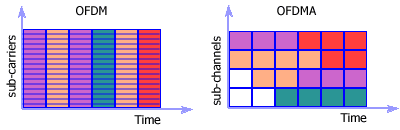 Subchannelization in the uplink can save a user device transmit power because it can concentrate power only on certain sub-channel(s) allocated to it. This power-saving feature is particularly useful for battery-powered user devices, the likely case in Mobile WiMAX.
 Subchannelization in the uplink can save a user device transmit power because it can concentrate power only on certain sub-channel(s) allocated to it. This power-saving feature is particularly useful for battery-powered user devices, the likely case in Mobile WiMAX.
The WiMAX forum established that, initially, OFDM-256 will be used for fixed-service 802.16d (2004). It is referred to as the OFDM 256 FFT Mode, which means there are 256 subcarriers available for use in a single channel. Multiple access on one channel is accomplished using TDMA. Alternatively, FDMA may be used.
On the other hand, OFDMA 128/512/1024/2048 FFT Modes have been proposed for IEEE 802.16e (mobile service). OFDMA 1024 FFT matches that of Korea’s WiBRO. OFDM 256 also is supported for compatibility with IEEE 802.16d (fixed, 2004).

Comments
Tell us what you're thinking...
and oh, if you want a pic to show with your comment, go get a gravatar!